.png)
About Scalapay
Scalapay is one of Europe’s fastest-growing payment companies, valued at more than $1bn and trusted by millions of customers and thousands of merchants across Europe. As a high-growth organisation, Scalapay needed to ensure its operational processes could scale efficiently, whilst also protecting its customers from fraudulent or illicit sellers.
The Challenge
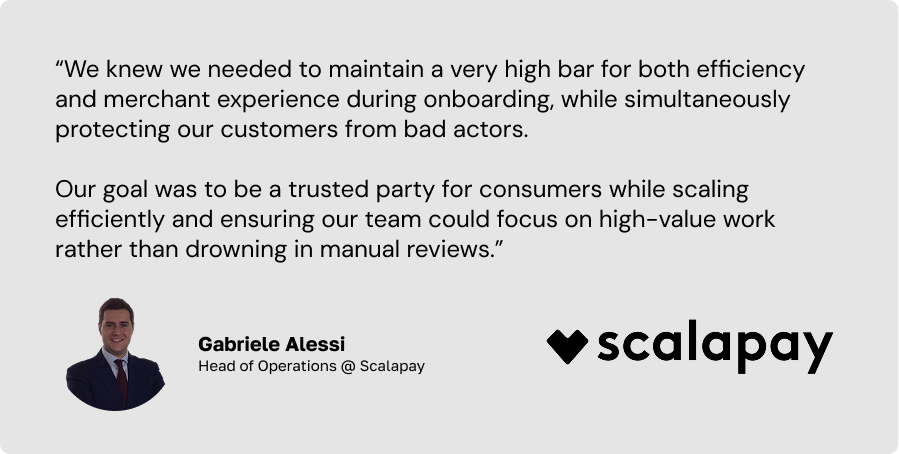
Scalapay’s rapid rise brought with it new pressures behind the scenes. As the company expanded across Europe, its risk and compliance teams were confronted with a growing workload, fuelled by the surge of new merchants applying to join the platform. Keeping pace with this demand without slowing down the business was an urgent priority.
At the same time, Scalapay wanted to deliver a frictionless experience for its merchant partners. Every additional delay in onboarding risked slowing the company’s momentum and frustrating merchants eager to get started.
Above all, protecting consumers remained paramount. With more merchants came greater exposure to potential bad actors, from sellers of illicit goods to outright scammers. Scalapay needed to ensure only trusted merchants were approved, safeguarding both the business and its customers.
The Solution
To meet these challenges, Scalapay partnered with Diligent since early 2024.
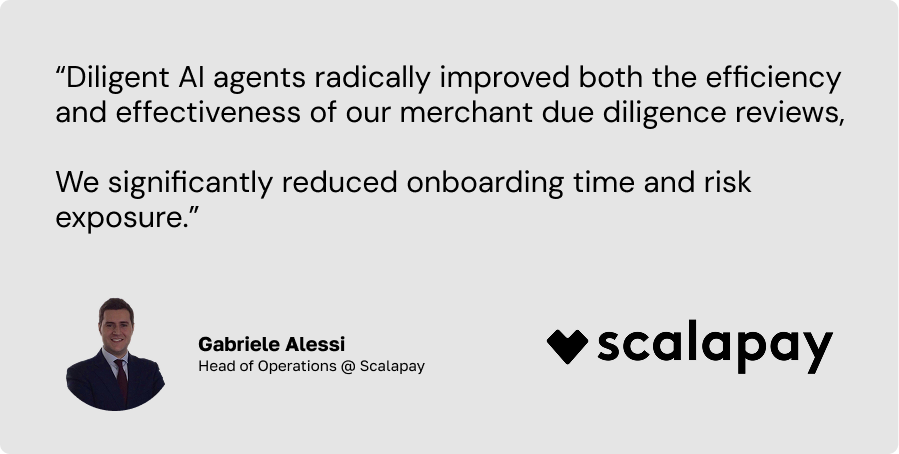
By embedding AI into its risk and compliance processes, Scalapay was able to move beyond slow, manual reviews and adopt an approach that could scale with the business. The new system gave the team the ability to expand risk and compliance capacity without needing to continually add headcount, while also ensuring a smoother and faster onboarding experience for legitimate merchants.
Just as importantly, AI-driven checks made it possible for risk analysts to focus on reviewing high-risk cases and complex scenarios.
With time to live less than 1 month, Diligent enabled Scalapay to continue its rapid growth while maintaining rigorous compliance and consumer protection.
The Results
Within the first year, Scalapay achieved measurable improvements across both efficiency and fraud prevention:
- 65% reduction in manually reviewed risk queues and false positive alerts – cases historically reviewed manually now processed automatically.
- 6,000 hours saved from manual reviews – equating to thousands of operational hours saved annually.
- Double digit % reduction in merchant fraud rates – lowering exposure to bad merchants and protecting consumers from scams.
Looking Ahead
With Diligent powering its merchant diligence and fraud detection processes, Scalapay has unlocked the ability to scale confidently. The partnership ensures Scalapay continues to grow rapidly without compromising on consumer trust or operational efficiency.
.png)